Jun 17, 2026
Hardware's Generational Moment: A Fireside Chat with Roelof Botha
EventGabriel Louis-Kayen
Flow's Founder, Pari, sat down with Roelof Botha (Sequoia partner and SpaceX's newest board member) to discuss where hardware is headed: the org design shaping next-generation engineering companies, why iteration speed compounds, and what AI now makes possible.
“The most valuable technology companies still build things.”
Hardware is having a moment.
For much of the last two decades, software dominated the technology conversation. But Roelof opened with a statistic that challenges the conventional narrative:
If you look at the data, 34 of the top 100 public companies in the world today are technology companies. Of those 34, 22 are unambiguously hardware companies.
He went on to argue that even many of the companies classified as software derive a meaningful portion of their advantage from hardware, whether that's robotics, custom silicon, manufacturing, or tightly integrated physical systems.
Hardware is not re-emerging so much as reasserting its importance.
Several forces are driving that shift at once. Advances in software are making hardware development faster. Trade tensions, export controls, and the growing focus on sovereign industrial capability are driving renewed demand for domestic manufacturing and resilient supply chains. Robotics is reducing the cost of production. Across industries, the boundary between hardware and software is becoming increasingly difficult to separate.
The result is a new generation of companies building products where software intelligence and physical systems are inseparable.
“Speed ends up being the key determinant.”
When asked what separates the best companies from the rest, Roelof's answer was immediate: speed.
Across decades of investing and observing hundreds of companies, the pattern is remarkably consistent. Winning companies compress the cycle between learning, iteration, and decision-making. Admittedly, it’s harder to compress the cycle in hardware given decisions are deeply interconnected and expensive to reverse. A software bug can often be fixed with an update. A mistake in hardware can take months to unwind and, in the worst case, require a recall.
That is precisely why iteration speed matters so much. The best hardware teams shorten the time between making a decision and learning whether it was the right one. As engineering complexity grows, the ability to accelerate that learning cycle without lowering standards becomes one of the most important advantages a company can build.
"All of you wish you were still a 150-person company."
Much of the conversation around AI focuses on individual productivity. Roelof argued that the larger opportunity may be organizational alignment.
Small companies move quickly because information moves quickly. The people closest to customers and technical problems can make decisions with relatively little coordination overhead. Every company is ultimately the sum of thousands of individual decisions, and smaller organizations often keep those decisions aligned more easily.
As programs scale, that breaks down. Mechanical, electrical, software, manufacturing, testing, regulatory, and supply chain teams all contribute to the same product but are working in different tools, under different constraints, and owning different pieces of the system. Coordination becomes its own discipline, and hierarchy emerges to move information between the people who have it and the people who need it.
The enduring challenge for growing organizations is preserving the speed, ownership, and accountability of a ~150-person company while operating at a much larger scale. By lowering coordination costs and making context more accessible, AI allows more decisions to be made by the engineers and operators closest to the problem. The next generation of hardware organizations will look less like rigid hierarchies and more like networks of highly accountable builders working toward shared outcomes.
“It's crazy not to make this change.”
A recurring theme throughout the conversation was that the cost of inaction may be higher than the cost of experimentation.
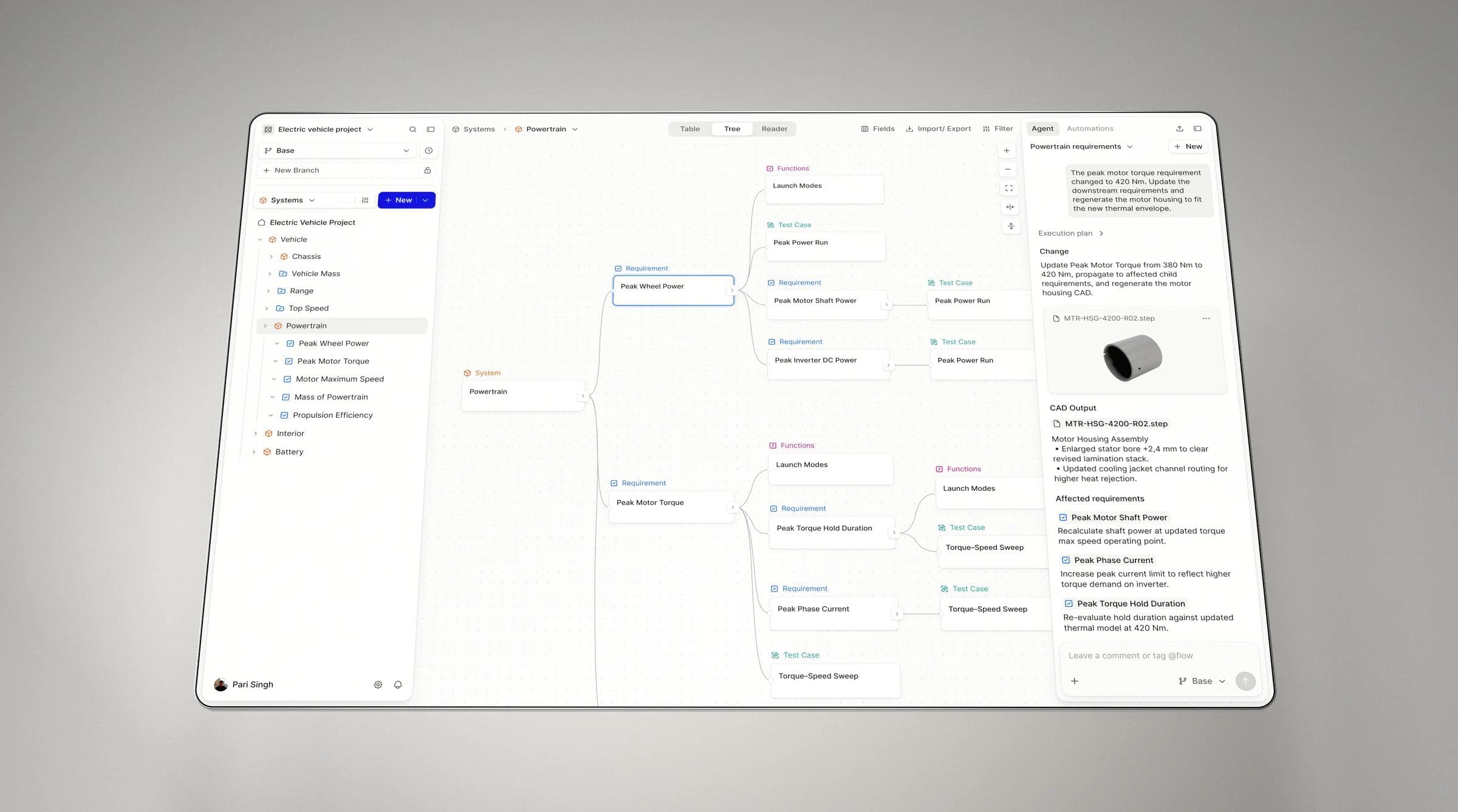
Every major technological shift creates a period where organizations diverge. Some embrace the new capabilities early and compound the benefits. Others wait and find themselves competing against companies operating on entirely different timelines. The change is not simply adopting AI as another piece of software or tool. Rather, it’s rebuilding how engineering organizations operate: shortening feedback loops, increasing the rate of iteration, and allowing people and agents to work together in ways that were not previously possible.
The compounding effect matters. Faster iteration leads to faster learning. Faster learning leads to better decisions. Better decisions create even more opportunities to move quickly. Technology diffuses quickly, but organizational capability does not. By the time everyone has access to the same tools, the leaders may already have years of accumulated advantage.
“The spec is the design.”
As AI has become more capable, many software teams have arrived at the same conclusion hardware teams arrived at years ago: generating code is no longer the hardest part of building software. Defining what the system should do is (i.e., establishing the requirements, constraints, interfaces, and tradeoffs that shape a design). The implementation follows from there.
Hardware teams have always treated specifications as first-class engineering artifacts. Requirements documents, interface definitions, verification plans, and system architectures exist because successful programs depend on clear intent long before anything is manufactured.
As tools become more capable, clear specifications become even more valuable. Models can regenerate code, rerun analysis, and produce artifacts. They cannot infer intent that was never made explicit.
For all the discussion about new technologies, new organizational structures, and new ways of working, the conversation ultimately returned to a familiar hardware engineering principle: the quality of the output is determined by the quality of the specification behind it. As implementation becomes cheaper, specification becomes more valuable.